Showing posts with label chevrolet. Show all posts

Wednesday, March 16, 2016

Motor Trend NEW 2017 Chevrolet Camaro ZL1 First Look Review

2017 Chevrolet Camaro ZL1
  What if a Corvette Z06 had four seats? It’s a question more than a few people have no doubt asked themselves when trying to rationalize a Z06 with the realities of family life and one Chevrolet appears to be answering with the all-new 2017 Camaro ZL1.

  No, a Camaro isn’t a Corvette, but hear us out. This new ZL1 uses the Z06’s LT4 6.2-liter, supercharged V-8 fitted with a Camaro-specific intake, two-mode exhaust, and computer tuning. It’s good for 640 hp and 640 lb-ft of torque. It employs magnetorheological shock absorbers like the Z06, careful aerodynamic tuning like the Z06, scads of fluid coolers like the Z06, an electronically controlled limited-slip differential like the Z06, a Drive Mode Selector and Performance Traction Management like the Z06, big Brembo brakes like the Z06, the Performance Data Recorder like the Z06, and racing seats like the Z06. The only thing the ZL1 didn’t copy is its looks.

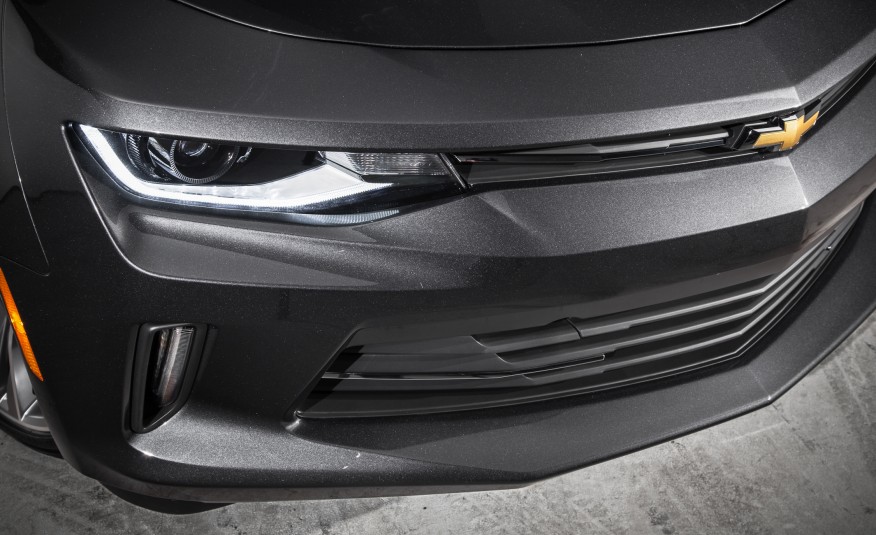
Even if it’s not identical to the Z06, there’s a lot to like here. Where the old ZL1 was more dragstrip than road course, this one’s designed for curves. Adjustable magnetic shocks are standard, as is the electronically controlled limited-slip and the Recaro race seats. The exterior has been extensively reworked in the wind tunnel and on the Nürburgring to improve aerodynamics and features a big front splitter and rear wing, new rockers, wider front fenders, new underbody panels, a larger lower grille for more airflow, new front brake-cooling ducts, and a new hood with a carbon-fiber vent. The old Z/28’s famous “flow tie,” a hollowed-out Chevrolet bow tie badge that allows for more airflow into the radiator, makes its return on the upper grille. No need to worry about overheating, either; a ZL1 aerodynamics engineer told us that while keeping the LT4 cool is always a challenge, his team was able to shoehorn 11 heat exchangers into the Chevy. Like the Camaro SS, the ZL1 rides on 20-inch wheels at all corners, but now they’re wearing 285-width front and 305-width rear tires. Specifically, Goodyear Eagle F1Supercar tires designed for the ZL1. They’re backed by six-piston front and four-piston rear Brembo calipers chewing on 15-inch front and 14-inch rear rotors, themselves 1.5 and 1.0 inches larger in diameter than on the SS, respectively.

The lower curb weight will further enhance the new ZL1’s cornering ability. Chevrolet claims the new car is 200 pounds lighter than the old one, which would make it about 3,850 pounds based on our measurement of the previous ZL1. That’s about 150 pounds heavier than the SS, but the extra 60 hp and 84 lb-ft ought to handle it fine.


Handling that extra power will be a standard six-speed manual gearbox with active rev-matching and performance gearing. Chevrolet’s all-new, paddle-shifted 10-speed automatic (co-developed with Ford, in an amusing twist) is optional; the company claims it will offer incredibly fast gearshifts and close gear ratios. It’ll be GM’s first application of the new transmission and will be rolled out to numerous other products in the near future.

That’s the hardware, and there’s equally impressive software to go with it. Chevrolet’s excellent Performance Traction Management system, which allows the driver to dial in as much or as little assistance as desired, is standard. The ZL1 is also equipped with a Drive Mode Selector, letting you toggle from Eco mode all the way up to Track. It’s also got a new trick: Custom Launch Control, allowing you to dial in the exact launch rpm you need based on track conditions at the strip. Chevy’s Performance Data Recorder, which allows you to record video and data from your hot laps, is available.

Chevy is so confident in the Camaro ZL1’s track credentials that GM president Dan Ammann and executive vice president of global product development Mark Reuss surprised journalists with track rides at Nevada’s Spring Mountain Raceway on the Camaro Convertible launch. With Ammann and Reuss at the wheel, the 10-speed-equipped ZL1s were a thrilling ride. The Camaro is thrillingly quick—it hooks up and accelerates smoothly without the violence of something like a Challenger Hellcat. The 10-speed automatic appeared to shift instantly at the pull of the steering wheel-mounted paddles as the GM execs rattled up and down through the first six gears on the track. The Magnetic Ride shocks helped keep the Camaro ZL1 flat through corners, and it shrugged off the track’s curbing, much like the old Camaro Z/28.

After the lap we had a chance to catch up with Al Oppenheiser, the chief engineer behind the new Camaro. When we asked him if the new ZL1 was quicker around the track than the Z/28, he said, “The ZL1’s benchmark was the Z/28. And you know what benchmarks are for.”

The old ZL1 was good for a 3.9-second sprint to 60 mph at a 12.2-second quarter mile at 116.6 mph on our test track, and we expect this lighter, more powerful car to bring those times down and that trap speed up. The old car’s 0.99 average sustained g and 24.0-second figure-eight lap time at 0.85 average g are both likely to bested, as well. The last ZL1’s 100-foot 60-to-zero stopping distance will be tough to beat, but that will probably fall, too. Given that old ZL1 was nipping at the heels of the 707-hp Dodge Challenger Hellcat on the dragstrip, this new car will likely outrun the Hellcat just as easily as it runs circles around the big coupe. Ford, if it does another Mustang GT500, will have a hell of a fight on its hands.

You can get yours late this year, sometime in the fourth quarter. Pricing hasn’t been announced, but the old model’s $57,650 starting price is likely indicative of where this new ZL1 will start.

2016 Chevrolet Camaro ZL1
PRICE $60,000 (est)
LAYOUT Fr-eng, RWD, 4-pass, 2-door coupe
ENGINE 6.2L/640-hp/640-lb-ft s’ch’d OHV 16-valve V-8
TRANSMISSION 6-sp man; 10-sp auto
CURB WEIGHT 3,850 lb (MT est)
WHEELBASE 110.7 in
LENGTH x WIDTH x HEIGHT 188.3 x 74.7 x 53.1 in
0-60 MPH 3.3-3.5 sec (MT est)
EPA ECON 13-15/21-24/17-19 mpg (est)
ON SALE Winter 2016

Credit to: MotorTrend

Friday, January 15, 2016

Meet The All New 2016 Chevrolet Camaro: Trim, Toned, and Out for Blood

2016 Camaro RS

Laying the Groundwork

The most potent weapon in the new, sixth-gen Camaro’s arsenal is its platform. The new car sits on GM’s Alpha architecture, the foundation on which the Cadillac ATS and CTS have built their reputations for kick-ass dynamics. Chevrolet says that the new car is 28 percent more structurally rigid than the last one, and that some 70 percent of its Alpha component set is unique to the 2016 Camaro. (This seems like a good point to drop in the fact that the only carry-over part numbers are said to be the bow tie on the decklid and the SS badge.) The Alpha bones make for a slightly smaller Camaro in every dimension; the 2016 is 2.3 inches shorter overall, 0.8 inch narrower, and 1.1 inch shorter in height. The wheelbase is down by 1.6 inches, and the track measurements, front and rear, are reduced by between 0.4 and 1.1 inch, depending on trim level.
All the decimal shaving results in a car that, depending on the trim level, is more than 200 pounds lighter at the curb, according to Chevrolet; the body-in-white alone is down by 133 pounds. Even before we dive into the rest of the chassis and powertrain details, that’s already promising—weight is the enemy of performance, after all. Rendering the cross-dash beam in aluminum instead of steel saved 9.2 pounds, while 26 pounds were pulled from the suspension by using aluminum links up front and punching holes into the steel links fitted out back. Once again, the front end is suspended via struts while the rear gets a multilink arrangement; GM’s sublime Magnetic Ride Control active dampers will be available for the first time on the Camaro SS.

Every Camaro can be equipped with Brembo brakes, and the branding is standard—and the pieces beefier—on the SS. Non-SS models get 12.6-inch rotors squeezed by four-piston calipers at the front and 12.4-inch discs and single-piston calipers out back, while the SS upgrades to four-piston fixed calipers all around and 13.6- and 13.3-inch rotors. Eighteen-inch wheels and Goodyear Eagle Sport all-seasons are stock on non-SS models, and they can be upgraded to 20-inchers with Eagle F1 Asymmetric run-flats. The SS will roll off the Lansing, Michigan, assembly line with 20-inch wheels wrapped in Eagle F1 Asymmetric 2 run-flats (you know, for twice the eagle-ness).


Powertrain: 4-6-8

The 2016 Chevrolet Camaro engine lineup is very similar to the Mustang’s, as it features a turbocharged four-cylinder and naturally aspirated V-6 and V-8 options, but the blown four will serve as the base motor in the Chevy. The two smaller engines will be available in both LT and 2LT guise (they’re the only two trims with those engines), while the eight-cylinder is again SS-exclusive. In contrast, the V-6 Mustang is the bottom feeder and available with very little in the way of options.

 The four—the first in a Camaro in 30 years—and the six can be ordered bolted to a Tremec TR3160 six-speed manual transmission or GM’s 8L45 eight-speed automatic. The SS gets the same transmission types and gear counts, but the manual is the familiar Tremec TR6060 (now with active rev-matching) and the automatic is the 8L90 that’s also available in the latest Corvette.

The 2.0-liter turbocharged engine makes 275 horsepower and 295 lb-ft of torque, just about equal with its output in the Cadillac ATS and CTS. Chevy says it’ll return more than 30 mpg on the highway and hustle the Camaro to 60 mph in less than six seconds, although the company doesn’t specify which transmission achieves those numbers. For reference, we’ve tested the EcoBoost Mustang and achieved zero to 60 mph in 5.5 (manual) and 5.2 seconds (automatic). GM’s 2.0-liter is too coarse and uneven in its Cadillac applications, but hopefully the Camaro wizards have found a way to smooth out the power delivery. We also wouldn’t mind if they made it rev a little more freely.

The V-6 may seem familiar—it displaces 3.6 liters and features direct injection like the one already offered in plenty of GM’s finest wares—but it’s a thoroughly redesigned unit that has a wider spread between its banks, features a one-millimeter larger bore (adding 76 cc’s to the six’s displacement), and can now shut down cylinders in light-load situations to conserve fuel. It makes a healthy 335 horsepower and 284 lb-ft.

The Mustang GT–fighting SS gets the 6.2-liter LT1 V-8 that debuted in the Corvette Stingray, albeit with 20 percent Camaro-specific parts, including tri-Y-shaped exhaust manifolds. (We hope that some of the new bits sort out the LT1’s woes; an allegedly bad oil filter caused our long-term Corvette’s engine to die a premature death, and our Vette has also experienced starter-motor problems.) Unlike in the fifth-gen car, where manual-transmission versions offered more muscle, every Camaro SS will pack the same heavy—and Corvette-matching—punch, in this case 455 horses and 455 lb-ft. That’s up 29 horsepower and 35 lb-ft on manual models and 55 horsepower and 45 lb-ft on automatics. (Listen to the Camaro’s LT1 here.) Yes, like the Mustang and a billion German cars, the Camaro will feature engine-audio enhancement. The 2.0T models all will have active noise cancellation and will even pump fake noise into the cabin if you get the upgraded Bose stereo. Chevrolet makes a point to note that the aural fake-itude can be switched off, though, which is nice. Camaros equipped with the two larger engines get induction-noise resonators—pipes that feed intake noise directly to the interior—and offer dual-mode active exhausts that can be set to “stealth” mode to avoid pissing off any neighbors you might actually like.
Finally, a Drive Mode Selector tailors up to eight variables through Snow/Ice, Tour, Sport, and Track (SS only) programs, including launch control, shift mapping in automatic models, throttle sensitivity, exhaust sound, steering weight, the stability control, magnetic shocks, and interior lighting


Article by: Car and Driver  Click for full read.

Saturday, October 5, 2013

No-lift Shifting in the Camaro ZL1

No-lift shift isn’t new to GM. The Chevrolet Cobalt SS and HHR SS had it, the Buick Regal GS and the Cadillac CTS-V have it, but the 2014 Chevrolet Camaro ZL1 wears it best.

Imagine you’re at a drag strip. You put the 2014 Chevrolet Camaro ZL1 stability system into Race mode, inch up to the starting line until you fully stage, then put your right foot flat onto the accelerator pedal to turn on launch control. After the engine figures out what rpm to launch at, you ease your foot off of the clutch to go. The 2014 Chevrolet Camaro ZL1 charges forward, the tachometer’s needle approaches redline, and it’s time to shift. This is usually when you’d take your right foot off of the accelerator pedal, push the clutch pedal in with your left foot, shift into second gear, raise your left off of the clutch, and slam your right foot down onto the accelerator pedal again—but that’s not what’s going to happen this time.

With your right foot firmly planted on the accelerator pedal, your left foot hovers just above the clutch pedal. Then you start to push down it. For a second, every muscle in your body tenses off as you imagine obliterating the supercharged V-8 engine or the 6-speed manual transmission by doing what you’re about to do. Then you remind yourself that this engine is tuned for no-lift shifts. If you don’t use the feature, the supercharger won’t maintain boost between gears. So you ram your left foot down onto the clutch pedal, there’s a loud blat from the exhaust, your right hand yanks the transmission into second gear, and you get your left foot off of the accelerator as fast as you can. The 2014 Chevrolet Camaro ZL1 surges forward, completely unscathed. Ditto for the next two shifts. As you cross the finish line in just over twelve seconds, you realize that the accelerator pedal has been on the floor since the start of your quarter-mile run.


Info from: Camaro5.com

Friday, January 4, 2013

The 580HP 2012 Chevrolet Camaro ZL1

Our old pal Jonny Lieberman gets to have all the fun. The former Autoblog editor now gets to play with multiple supercars at a time for his post at Motor Trend. As part of MT's Best Driver's Car award process, Lieberman and the rest of the magazine's team quarter-mile all of the year's contenders in what they call "The World's Greatest Drag Race." Based on the contenders, we're inclined to agree with their bluster.

While last year's race saw the Nissan GT-R edge out the Ferrari 458 Italia, this year features a few new contenders, including the Lamborghini Aventador and McLaren MP4-12C. Other contestants include the Mercedes-Benz C63 AMG Black Series, Chevy Camaro ZL1, Ford Mustang Shelby GT500, Subaru BRZ, Jaguar XKR-S and Porsche 911 Carrera S, which – spoiler alert – actually won the Best Driver's Car award this year. Oh, and the updated version of Nissan's GT-R makes a repeat appearance, but no Ferraris are in the field this year.

A special thanks should go out to the Subaru BRZ. It was so far behind the competition that it provided many of the wide-angle shots that captured the whole rest of the field. The straight line is not the forte of a 200-horsepower drift-o-matic, but a fourth place finish in this year's Best Driver's Car competition is a mighty feat for this seemingly outmatched sports car.

The biggest competition in this drag race will be from the new Aventador and the MP4-12C. Do they have enough to take on a new Godzilla? You're just going to have to scroll down to find out. And make sure to stick around for the closing credits to hear each one of these contenders rev their engine in a sweet mechanical symphony.


News Source: AutoBlog.com, Motor Trend via YouTube

Friday, June 1, 2012

New Camaro ZL1 Convertible


2013 Chevrolet Camaro ZL1 convertible
Chevy released some specs for its Camaro ZL1 coupe, including output figures of 580 hp and 556 lb-ft of torque from its supercharged 6.2-liter LSA V-8. Now Chevy has announced that ZL1 will be available in ragtop form, too—and that it won’t be diluted. As such, the Camaro ZL1 will become the most powerful convertible ever to wear a bow tie. Shock? No. Awe? Yes.
Nearly all of the enhancements of the ZL1 coupe (which involved swapping or altering roughly a third of the regular Camaro’s parts) apply to the convertible as well, including the new front clip with stacked ancillary lights; the bulging, louvered hood; the beefed-up transmissions; the stronger rear-end components; and the quad exhaust pipes.  However, considering the lesser rigidity and extra weight of convertibles, the ZL1 convertible probably won’t be able to turn in the claimed 7:41.27 Nürburgring lap Chevy claims for the coupe. The Camaro SS ragtop weighs nearly 270 pounds more than the SS coupe, and we expect a similar discrepancy between the ZL1 duo courtesy of this version’s additional structural bracing. Even so, we predict that the convertible to run from 0 to 60 mph in just over four seconds and turn in a quarter-mile time of less than 13.

Camaro ZL1 Convertible
 
The ZL1 convertible will debut at the upcoming L.A. auto show before arriving at Chevrolet dealerships in late 2012; the coupe goes on sale early in the year. With Ford already prepping a 600-plus-horse GT500 coupe—a development we first reported last March—expect the Blue Oval to announce a similar GT500 convertible to face off with the ZL1.

 
2013 Chevrolet Camaro ZL1 convertible wheel


2013 Chevrolet Camaro ZL1 convertible grille


Camaro ZL1 LSA Supercharged Motor

Wednesday, August 10, 2011

Camaro Competitive Comparison

                                      2011 Chevrolet Camaro       2011 Ford Mustang 2dr     2010 Dodge Challenger     2010 Nissan 370Z 2dr
                                         Coupe SS 2SS                           Cpe GT Premium               2dr Cpe SRT8                 Roadster Manual
Powertrain


Standard Engine Gas V8 Gas V8 Gas V8 Gas V6
Displacement 6.2L/376 5.0L/302 6.1L/370 3.7L/-TBD-
Drivetrain Rear wheel drive Rear Wheel Drive Rear Wheel Drive Rear Wheel Drive
Horsepower @ RPM 426 @ 5900 412 @ 6500 425 @ 6200 332 @ 7000
Torque @ RPM 420 @ 4600 390 @ 4250 420 @ 4800 270 @ 5200
Fuel Injection Electronic Fuel Injection SMPI SMPI SMPI
4-Wheel ABS Standard Standard Standard Standard
4- wheel Disc Brakes Standard Standard Standard Standard


Competitive comparisons provided by Chrome Systems, Inc., an independent online automotive buyer's guide. GM and its advertising agencies are not responsible for this content. All prices and specifications are subject to change without notice. Prices do not include taxes, title, license and dealer fees. Photos may not represent exact vehicle or selected equipment. Copyright © 1998-2010 Chrome Systems, Inc. All rights reserved.

Chevrolet Harnesses Sun To Power Dealerships


Chevy Green Zone image

 by Chevrolet in the News on July 29, 2011

Chevrolet is taking sustainability to a whole new level with the installation of solar-powered charging stations at Chevrolet dealerships. These new chargers are to be installed at two dozen U.S. dealerships to generate electricity equivalent to 12 full vehicle charges per day. Excess energy will be used to supplement the dealerships’ daily power needs.
American Chevrolet in Modesto, California, and Al Serra Auto Plaza in Grand Blanc, Michigan, are the first U.S. dealerships to complete their solar charging capability. Each solar canopy generates enough electricity for up to 4,500 charges per vehicle annually.
“The question isn’t whether to install a solar canopy, it’s where and how many,” said Joe Serra, president of Serra Automotive. “It’s a win for us because the electricity generated will help reduce operating costs, and it’s a win for the environment since solar power helps reduce our carbon footprint.”
The installation of solar chargers has been dubbed the Green Zone initiative. The initiative is part of GM Ventures’ recent announcement to invest $7.5 million in Sunlogics, a solar panel manufacturing and development company that will supply the panels and install the dealer charging stations.
“The Chevrolet Green Zone will provide our U.S. dealers with added flexibility when it comes to charging their vehicles, while also reinforcing GM’s commitment to renewable energy projects,” said Chris Perry, vice president, Global Chevrolet Marketing and Strategy.
GM has already installed some of the largest automotive rooftop solar power installations in the United States. The automaker even installed the world’s largest rooftop solar installation at its car assembly plant in Zaragoza, Spain. Additionally, GM is currently building a new solar field at its Detroit-Hamtramck facility, which manufactures the Chevy Volt.
“The beauty of this program is that there is no capital cost required from the dealership,” said Dave Halvorson, president of American Chevrolet in Modesto. “Not only do we generate the solar energy to increase our reliance on renewable electricity, but the Green Zone is a billboard of our commitment to the environment.”

2012 Corvette ZR1 Makes Record-Setting


Chevrolet Corvette ZR1 image
ZR1

 by Chevrolet in the News on August 1, 2011

After an absence of four years, the Chevrolet Corvette once again returned to Germany’s famed Nürburgring racetrack for performance testing, and once again it came home with a record. Corvette engineer Jim Mero drove a stock 2012 Chevrolet Corvette ZR1 through the 12.9 miles and 154 turns of the ’Ring’s Nordschliefe course in a time of just 7:19.63—the fastest confirmed time ever recorded by a stock production vehicle.
But that was just a bonus for the Corvette team, which was at Nürburgring to validate some key performance upgrades on the ZR1 for 2012, including its available Michelin Pilot Sport Cup Zero Pressure tires. An important factor in helping the Corvette set its new Nürburgring benchmark, these competition-oriented tires are optimized for warm, dry conditions to provide enhanced cornering and handling capabilities. In fact, working in concert with the Corvette’s exclusive torque-management system, the net result for the 2012 model year is an 8 percent gain in maximum lateral acceleration—now increased to more than 1.1g—as well as decreased braking distances.
The ZR1, along with the entire Corvette lineup, also gets some notable interior upgrades for the new model year. Among them:
  • New, more supportive seats with larger bolsters and microfiber suede inserts
  • A new steering wheel, showcasing wrapped spokes, streamlined switch trim and model-specific badging
  • Contrasting interior stitching on models with leather interiors
  • A new uplevel Bose sound system with enhanced sound quality that’s been precisely tuned to the cabin’s acoustics; this nine-speaker setup also boasts the latest Bose Nd bass performance and new dash-mounted tweeters
  • Customizable brake calipers, available in red, yellow, silver or gray
And remember, all this is in addition to the potent package the ZR1 already brings to the table, filled with go-fast goodies like a 6.2-liter supercharged 638-V8 engine, Brembo carbon-ceramic brakes and Selective Magnetic Ride Control, the fastest-reacting suspension technology in the world.
It’s no wonder the 2012 model year also will bring one more significant addition to the Corvette roster—a seventh trophy for winning its class at the grueling 2011 24 Hours of Le Mans endurance race.